Impacts of AirBnB regulation in New York
New York has long been a money spinner for AirBnB. In January 2023 there were 38,500 listings. As…



New York has long been a money spinner for AirBnB. In January 2023 there were 38,500 listings. As…
In 2010 the Commonwealth Association of Planners held its first Student Essay competition. The winners were Jeremiah Atho…
Ken Loach’s film, Kes, was released in 1969. What does it tell us about life in a coalfield…



Cliff is a freelance consultant, researcher, author and trainer. He was the Chair of the Cockburn Association 2016 – 2023.
He is Professor Emeritus of Planning and Spatial Development at Heriot-Watt University in Edinburgh.
He is a Past President of the Royal Town Planning Institute, and of the Commonwealth Association of Planners.
He is a past Chair of Built Environment Forum Scotland.
He was awarded the O.B.E. in the 2016 Birthday Honours.
This blog was first published in October 2014,and is reproduced by kind permission of the editor of the Planning Resource website. Last week I was in Pakistan, speaking at an international conference on Town Planning and Urban Management. It was an opportunity to revisit Lahore for the first time in 20 years and to experience…
Resilience of cities is the theme of the latest issue of the French publication of Villes en Développement edited by my old friend Marcel Belliot. As the preface notes, resilience is now central to “approaches and strategies of governments partnering urban development and of funders.” It brings a holistic and interdisciplinary approach to understanding and managing urban development.…
This blog was first posted in August 2016. Today, it is the young people who most strongly uphold the ideal of Europe as a shared space, where people from different countries lie and work together. The Young Eyes project, that has involved teenagers from Poland, Latvia and Sweden and young professionals from Scotland, shows how…
UN-Habitat Support to Palestinians at risk of displacement in Israeli Controlled Area C of the West Bank, 2014-15. Commonwealth Secretariat Developing Urban Planning Education, 2011. Managing urbanisation in small developing states, 2011. Hungarian EU Presidency The Territorial State and Perspectives of the European Union: Update 2011 http://www.bbsr.bund.de/BBSR/EN/SpatialDevelopment/SpatialDevelopmentEurope Department for International Development Making Planning Work, 2006.
Scotland’s fourth National Planning Framework puts climate and nature centre-stage. The Scottish Government is seeking to “transform planning” by putting the twin crises of climate and nature at the heart of the planning system. National Planning Framework 4 is one of the first national-scale planning documents in the world to confront the urgent challenges of climate…
This blog was first posted in June 2015. There will be another 2 billion people living in urban areas by 2030. With a billion people now living in slums,and over 100,000 homeless people in Delhi, for example, it is no exaggeration to say that this is a critical decade for cities and the practice of…
Ghana’s fifth National Urban Forum was convened on 25 August to reflect on the theme “Building Resilient Cities: Deepening Spatial Planning and Land Value Capture for Development in Ghana.” Previous meetings of the Forum have contributed to the Ghana Urban Policy and its Action Plan to improve city conditions. The Ghana Urban Agenda has been accepted at…

This blog was first posted in October 2019. Inside the slums and gated communities the opportunities and obstacles to sustainable and inclusive urban development can be seen. Spending a few days in Delhi as part of the Sustainable, Healthy and Learning Cities and Neighbourhoods project has given me insights into the way urbanisation is taking place in…
The figure of Hans Clauert is used in public art in the centre of Trebbin to brand the town. How do you make small towns in rural areas more attractive? This is the central concern of a Baltic Sea INTERREG IVB project that I have been working on. Trans-in-Form brought together partners from Norway, Sweden, Germany, Poland,…
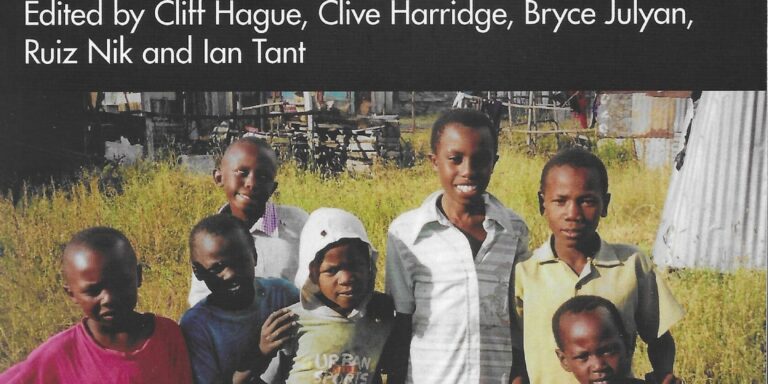
Ruthless developers are literally undermining a Kenyan school in an attempt to capture the rights to valuable land, alleges a priest with wide experience of the country. Most new development in Kenya is informal. Land piracy has long been a significant factor in urban development. Schools have become especially vulnerable, so much so that in…