Impacts of AirBnB regulation in New York
New York has long been a money spinner for AirBnB. In January 2023 there were 38,500 listings. As…



New York has long been a money spinner for AirBnB. In January 2023 there were 38,500 listings. As…
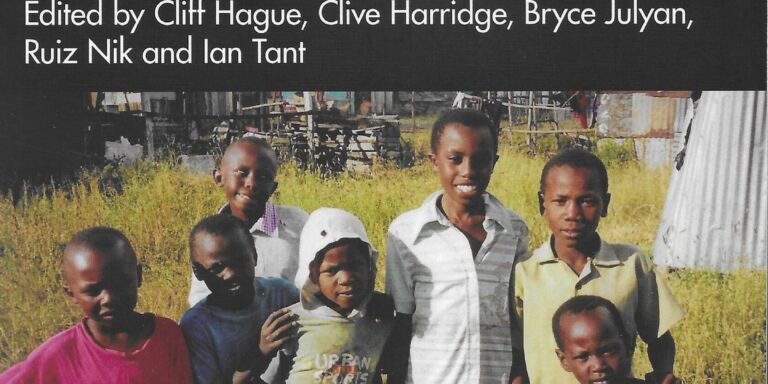
In 2010 the Commonwealth Association of Planners held its first Student Essay competition. The winners were Jeremiah Atho…
Ken Loach’s film, Kes, was released in 1969. What does it tell us about life in a coalfield…



Cliff is a freelance consultant, researcher, author and trainer. He was the Chair of the Cockburn Association 2016 – 2023.
He is Professor Emeritus of Planning and Spatial Development at Heriot-Watt University in Edinburgh.
He is a Past President of the Royal Town Planning Institute, and of the Commonwealth Association of Planners.
He is a past Chair of Built Environment Forum Scotland.
He was awarded the O.B.E. in the 2016 Birthday Honours.
ESPON 2013 is an applied research programme partly funded by the European Regional Development Fund and partly by the 28 EU member states, plus Iceland, Liechtenstein, Norway and Switzerland. Its research has built an evidence base to support policy development for territorial cohesion and development. Each country appoints a National Contact Point to interpret and…
Opportunities and threats for Territorial Cohesion: Blue Growth and Urban Poverty, Report from the ESPON Open Seminar in Nafplion – Greece, 4 and 5 June 2014 (2014) Co-author.
This item was posted in May 2016. I am pleased to confirm that I will become Chair of the Cockburn Association in June, when the present Chair, Lord Brodie, steps down. The Cockburn Association is one of the oldest urban conservation and planning organisations in the world. It was formed in 1875 and has a distinguished history…
What can planners in Scotland (and the rest of the UK) learn from thinking and practice in other countries? For World Town Planning Day 2019 I did a blog that extolled ideas nurtured in Scotland that had relevance for the rest of the world. Now it’s time to flip the focus and look the other way. In…
Like many planners I am a fan of the movies, and especially fascinated by films where place is central to the narrative. Over the weekend I was lucky enough to see not one, but two films about cities. They have a lot of similarities but also many differences. They areFellini’s Roma and Terence Davies’ reflections on…

The global pandemic raises some important questions about the links between public health and planning. With whole countries shut down and a soaring death toll, there are signs that it will not be long before a debate about the trade offs between health and economies becomes heated. At the moment, the professional body in the…
This blog was first posted in September 2017. The EU has rightly made the issue of Ireland a central element of the Brexit negotiations. What might be the territorial impact of creating an external border between Ireland and Northern Ireland? A cross-border conference in Dundalk, organised by RTPI, brought a sharp focus on the challenges…
This blog was first posted in December 2015. Klaus Kunzmann proposes a novel approach to staging the Olympic Games after Hamburg and Boston say “No”. Last week, in a referendum, the citizens of Hamburg voted against hosting the Olympics in 2024. To the surprise of the media and a very respected and supportive social democrat…
The INTERREG programmes aim to improve the effectiveness of regional policies and instruments within Europe. It promotes international cooperation and exchange of know-how between partners engaged in the making and delivery of policies and actions for regional and local development. Cliff has worked as an external expert on a number of INTERREG projects.
This blog was first posted on the Planning Resource website on 11 July 2011. A third of the world’s people are on the move, says Billy Cobbett, the Manager of Cities Alliance. Addressing the World Planning Schools Congress in Perth, Western Australia, Mr. Cobbett called for planners to transform the current wave of urbanisation into a sustainable…